Founder/CEO

Showing posts with label Harriet Tubman. Show all posts

Wednesday, July 01, 2026

Historic! NYS Governor Signs Harriet Tubman Byway Into Law

Pictured (l-r): Third row -Josh Poole, Sage Hazarika | Second row: Nikita Jankowski, Jasiah Jackson, Char Rivera, Ally Spongr DeGon, Senator April Baskins, Sara Capen, Saladin Allah | First row: Xochi Jankowski, Noble Jankowski, Anusha Quanaah, Nevaeh Everett, Governor Kathy Hochul, Assembly Majority Leader Crystal Peoples-Stokes, Stokes' granddaughter


New York becomes home to its first state-designated Underground Railroad byway, a 176.76-mile route from Auburn to Niagara Falls honoring Harriet Tubman and Freedom Seekers — the first phase of a planned 550-mile border-to-border heritage corridor connecting Maryland to Canada.

   On Saturday June 13th, New York Governor Kathy Hochul signed legislation officially designating Phase 1 of the Harriet Tubman Underground Railroad Byway (HTURB) as part of New York's Scenic Byway System, enacting Senate Bill S9057A and Assembly Bill A10194A. The signing took place in Buffalo to kick off the 2026 Buffalo Juneteenth Parade and marks the first official designation of the 176.76-mile heritage corridor connecting 22 sites significant to Harriet Tubman, the Underground Railroad, and Freedom Seekers across eight counties from the City of Auburn to Niagara Falls. The Governor was joined for the signing by Senator April Baskin, Assembly Majority Leader Crystal Peoples-Stokes, New York State Attorney General Letitia James, New York State Comptroller Thomas P. DiNapoli, and was surrounded by members of the HTURB team — including Ally Spongr DeGon, Sage Hamilton-Hazarika, and Saladin Allah — whose work helped bring the designation to fruition. Following the signing, the HTURB team walked alongside the Governor, Attorney General, and Comptroller in the Buffalo Juneteenth Parade to its conclusion. 

On the 50th anniversary of Buffalo’s Juneteenth celebration, there could not be a more fitting time to sign the Harriet Tubman Underground Railroad Byway into law. I thank Governor Hochul for her support of this legislation, Assembly Majority Leader Crystal Peoples-Stokes for sponsoring this bill in the Assembly, and Saladin Allah and Lillie Wiley-Upshaw, two Western New York leaders in African American history preservation whose years of advocacy helped make this designation possible. I would also like to uplift the hard work of the New York State Department of Transportation, which spent years working diligently to shape this worthy piece of legislation. This byway honors Harriet Tubman, the Freedom Seekers who traveled through New York, and the communities that risked everything to help them. It formally recognizes that the road to freedom ran through our state and will create new opportunities for heritage tourism, local businesses, and economic development. When people travel these roads, they will see visible reminders that freedom, courage and resistance traveled them first. -Senator April Baskin

“Harriet Tubman’s life is a study in leadership, determination and the universal concepts of liberty and freedom. As we approach the 250th anniversary of the founding of the United States, it is important to remember and to celebrate people who exemplify the ideals this nation was founded on. Harriet Tubman, without a doubt, is one of those people. Now Ms. Tubman’s legacy is further ingrained here in New York State with the Harriet Tubman Underground Railroad Byway. I thank my colleagues in the Assembly, Senate and Governor Hochul for getting this legislation passed and signed.” -Assembly Majority Leader Crystal Peoples-Stokes

“There is no state in the nation with a larger Underground Railroad footprint than the Empire State, and this legislation will highlight a network of important sites along a newly created byway honoring the legacy of the Underground Railroad and one of the fiercest freedom fighters in American history – Harriet Tubman – who ultimately called New York her home. Generations ago, the Underground Railroad carved a path through a divided continent and enabled thousands of enslaved people to gain their freedom. Through the creation of this new scenic byway, we honor the legacy of the men and women who made this dangerous journey, paving the way for a new birth of freedom for millions of African Americans.” -Governor Kathy Hochul


   With the bill now law, the New York State Department of Transportation (NYSDOT) — in partnership with the Harriet Tubman Underground Railroad Byway Organization — will soon begin installing signage marking the route and connecting Underground Railroad landmarks across Central and Western New York. The route begins in Auburn, Cayuga County, passes through Seneca, Ontario, Wayne, Monroe, and Orleans Counties, then continues through Erie and Niagara Counties, and ends at Niagara Falls. The byway honors Harriet Tubman — who made her home in Auburn for 54 years (and where she’s buried), after escaping slavery and leading 70+ Freedom Seekers to liberty — and the broader Underground Railroad network that ran through New York State. Once fully implemented, the byway will bring visitors to well-known New York State landmarks such as the Harriet Tubman National Historical Park, two National Historic Landmarks, and 14 National Park Service Network to Freedom sites. The scenic byway will also connect visitors to existing Black neighborhoods, businesses, and other sites, encouraging travelers to tour and support communities along the route. As needed and appropriate, additional interpretation — in the form of kiosks, exhibits, events, or experience centers — will enhance the visitor experience by connecting the traveler with the byway’s historical significance. Recreational activities along the byway, such as the Empire State Trail and Erie Canal, will further expand the diversity of experiences available to visitors.


ECONOMIC IMPACT

The eight Phase 1 counties already generate $5.67 billion in annual visitor spending, supporting more than 64,000 jobs. With the new byway, there is potential to increase that number. Maryland’s comparable Harriet Tubman Underground Railroad Scenic Byway contributes $23 million in annual sales and supports 363 jobs. The Journey Through Hallowed Ground National Scenic Byway generates $1.06 billion in total business sales and more than 6,500 jobs across four states. Cultural heritage travelers — the byway’s core audience — spend an average of $1,182 per trip.


THE ROAD AHEAD

With Phase 1 signed into law, HTURB — housed within the Niagara Falls National Heritage Area will begin implementing the Corridor Management Plan (CMP) in partnership with NYSDOT and the Underground Railroad Consortium of New York State (URCNYS). More than 100 volunteers and numerous organizations participated in creating the CMP and supporting the byway’s designation. Phase 2 will extend the byway from Auburn east through 14 additional counties to Manhattan and the New Jersey border, creating a contiguous 550-mile border-to-border corridor. Seventy-nine municipalities across Phase 2 counties have already passed resolutions of support. Phase 2 designation legislation is proposed for the 2027 legislative session. The long-term vision connects the New York Byway into a continuous multi-state route from Dorchester County, Maryland — Harriet Tubman’s birthplace — to St. Catharines, Ontario, Canada, where Tubman guided Freedom Seekers to safety. Linking with the existing Maryland, Delaware, and Pennsylvania Harriet Tubman byways, and the proposed New Jersey byway, the full corridor would become one of the most significant heritage travel routes in North America.


ABOUT The Harriet Tubman Underground Railroad Byway

The Harriet Tubman Underground Railroad Byway Organization is the independent governing body of the designated byway, housed within the Niagara Falls National Heritage Area (NFNHA). It oversees governance, stewardship, tourism development, and the corridor’s expansion to a full border-to-border route.

The Harriet Tubman Underground Railroad Byway (HTURB) is now a New York State Scenic Byway spanning 550+ miles from Manhattan to Niagara Falls across 22 counties and more than 160 municipal jurisdictions. Phase 1, signed into law by Governor Hochul on June 13, 2026, designates 176.76 miles from Auburn to Niagara Falls across 8 counties and 22 heritage sites. The byway was initiated by the Underground Railroad Consortium of New York State (URCNYS) — a non-profit volunteer coalition of historians, tourism officials, heritage attractions, and descendants of Freedom Seekers, founded in 2015 — and has grown into its own independent organization, the Harriet Tubman Underground Railroad Byway Organization, supported by URCNYS and administered by the Niagara Falls National Heritage Area. For more information, visit our Harriet Tubman Underground Railroad Byway (HTURB) HERE or follow @tubmanbywayny.

Wednesday, August 20, 2025

Executive Overreach and The Serpents Egg

1977 film by legendary Swedish filmmaker Ingmar Bergman
     

     On August 12th, 2025, the White House sent this letter to the Honorable Lonnie G. Bunch III, Secretary of the Smithsonian Institution regarding an Executive Order to Review its Exhibitions and Materials. This Executive Review is to make sure that these Institutions focus on “Americanism” in order to “Restore Truth and Sanity to American History.” Its aim is to “ensure alignment with the President’s directive to celebrate American exceptionalism, remove divisive or partisan narratives, and restore confidence in our shared cultural institutions.” This review will assess various aspects of the Smithsonian's operations such as its public-facing content (in-person exhibitions and online materials), curatorial processes and exhibition planning, draft plans for future shows, how collections are used to highlight American achievements, the development of narrative standards for exhibitions. Elaborating on this Executive Order, President Trump shared the below August 19th post on Truth Social regarding this federal directive:


     First and foremost, everything discussed at the Smithsonian Institute is not how horrible the country is, how bad slavery was, and how unaccomplished the downtrodden have been. Anyone who has visited a Smithsonian site knows that this statement is a boldfaced lie. There is a tremendous amount of success, brightness and future aspirations shown in numerous in-person exhibitions and online materials. To that point, the National Museum of African American History and Culture literally have a beautifully vibrant exhibition on Afrofuturism. It is worth noting that the term "WOKE" was first created by Black folks in 1930s and 1960s Protest Songs and recently popularized in Erykah Badu's song Master Teacher. This idea describes an awareness of racism, discrimination, prejudice and their harmful results. To be WOKE means that you possess the knowledge to identify and allude the pitfalls and traps of racism, discrimination, and prejudice. Let's be clear, whenever President Trump or any of his MAGA sympathizers dismiss, ridicule, or attack the idea of being WOKE, they are simultaneously denying that racism, discrimination, and prejudice exist against Black people. The statement, "This Country cannot be WOKE" means the U.S. cannot acknowledge that racism, discrimination, and prejudice exist against Black people because that is the perspective of poor Black people. This is the root of the attacks we have seen on Affirmative Action, DEI, Obamacare, Obama Phones, Reparations, and other initiatives impacting Black people. This is also what's behind the stereotypical claims to pathologize Black people as coming from sh*thole countries, eating dogs and cats, having toxic culture, playing the victim, playing the race card, being unmerited DEI hires, being reverse racists, poor, lazy, on welfare, looking for handouts, criminals, uneducated, and killing each other. 

  According to the White House, the initial Phase I to review the Smithsonian Institute's exhibitions and materials will focus on the following eight museums listed below. Additional museums will be reviewed in Phase II.

  • National Museum of American History
  • National Museum of Natural History
  • National Museum of African American History and Culture
  • National Museum of the American Indian
  • National Air and Space Museum
  • Smithsonian American Art Museum
  • National Portrait Gallery
  • Hirshhorn Museum and Sculpture Garden

     Who is doing the reviewing? White House appointees/attorneys. Not historians, scholars, curators, or subject-area experts. This would be equivalent to someone who only has a background in sports entertainment serving as the U.S. Secretary of Education. In that position to lead the Department of Educationthis person is responsible for reviewing and developing national education policies, overseeing federal education programs, supporting teachers, and ensuring equal access to quality education for all students. Whether it's former World Wrestling Entertainment executive Linda McMahon as the Secretary of Education, former Fox News Host Pete Hegseth as the Secretary of Defense, or Lee Zeldin as Administrator of the EPA with no background in environmental issues, inexperienced federal appointments like this have become the norm of the Trump Administration. Some have argued that this is not problematic. Yet these are the same people who would have a problem with someone who has no medical background reviewing their medical records and developing a health recovery plan for them or a family member. Like it or not, these appointees and others are responsible for developing a health recovery plan for America.

Submission Timeline

Below is the scheduled compliance timeline highlighted in this letter to the Smithsonian Institute.

Within 30 days of receipt of this letter, we anticipate:

  • Each museum to submit all requested materials outlined in the first four bullet points above, including current exhibition descriptions, draft plans for upcoming shows, America 250 programming materials, and internal guidelines used in exhibition development.
  • Review of America 250 exhibition and program planning and connect with curators and staff about their specific proposals.
  • A staff liaison from each museum will be designated to serve as the primary point of contact throughout the review process.
  • Our team will begin on-site observational visits, conducting walkthroughs of current exhibitions to document themes, visitor experience, and visual messaging.

Within 75 days:

  • Museums are asked to submit the remaining requested documentation (items 5 through 10), including promotional literature, grant data, educational materials, and guided tour content.
  • Our team will begin scheduling and conducting voluntary interviews with curators and senior staff. These conversations will help us better understand each museum’s goals and the broader curatorial vision guiding the institution.
  • Each museum should finalize and submit its updated plan to commemorate America’s 250th anniversary and ensure coordination with the White House Salute to America 250 Task Force to align messaging and public engagement.

Within 120 days:

  • Museums should begin implementing content corrections where necessary, replacing divisive or ideologically driven language with unifying, historically accurate, and constructive descriptions across placards, wall didactics, digital displays, and other public-facing materials.

The White House also stated, "If all benchmarks are met on schedule, we anticipate completing our review and preparing a final report for your review in early 2026. This report will include museum-specific assessments, institutional trends, and constructive recommendations for future exhibition strategy." 

Executive Branch Overreach

     President Trump is the only President in American history to call for a review of the Smithsonian Institution. According to the Organization of American Historians (OAH) who have openly condemned this order, the Smithsonian Institution was “established by Congress in 1846 as a unique and independent agency" and "is not, and has never been, under the authority of the Executive Branch." The OAH went on to state that the Smithsonian "is an independent statutory agency, led by the Secretary and governed by a bipartisan Board of Regents as established by law." In a statement by American Association for State and Local History (AASLH) it shared, "The administration’s directive ignores our field’s scholarship and the will of the American people, who have repeatedly said they want to explore the nation's history in all of its depth and complexity. The directive removes crucial context that audiences need for a fuller understanding of the past and its relevance to today. It is also an affront to the public’s right to think for itself." As congressionally chartered and independent, the Smithsonian Institute is not part of the U.S. government's Executive Branch. Thus, the White House, and any President, does not have the authority to direct the Smithsonian's internal operations, museum exhibits, or interpretive content.

     What consequence do these institutions face for not following this directive as a part ofExecutive Order 14253? Potential funding restrictions like we have seen educational institutions face via Executive Order 14238, titled "Continuing the Reduction of the Federal Bureaucracy." The Center for American Progress (CAP), an independent non-partisan policy institute has tracked how the White House's Executive Orders have impacted states and higher learning institutions by Mapping Federal Funding CutsWhat this order also does is set a national standard of censorship and suppression of history. The direction to remove improper ideology that does not show allegiance to the traditions, institutions, and ideals of the United States, as defined by federal government appointees, sets the stage for the rewriting of history. This also undermines the trust in institutions, especially by historians, scholars, researchers, documentarians, curators, subject-area experts, and educators who have researched, documented and teach non-revisionist history. Lastly, this attack on scholarship and academic exploration instills fear in those to not present counter narratives that will conflict with the government's review standards, or face repercussions -which may be severe. What is also important to consider is how this federal overreach sets a precedence on a state, regional, and local level. 

How does this affect everyday people? 

     The Smithsonian Institution is a national standard of excellence in museum collections, scholarship, education, and scientific exploration. What happens on the national level informs institutions on a regional and local level. This is where they receive their marching orders, especially with the added pressure of losing federal funding. In the area of WNY (Western New York) I have seen this effecting a number of institutions. As a host for the show What's Next? on BTPM (Buffalo Toronto Public Media) and which receives funding from the Corporation for Public Broadcasting, an entity that was recently defunded by the U.S. government and is shutting down. As an Adjunct Professor at Niagara University, I have also watched extreme cuts to their programs and staff due to the changes within the federal government. Libraries, museums, educational institutions, and regional/local policy makers are all feeling the pressure to comply with the federal government's expectations, which are often not under the legal jurisdiction of the U.S. government's Executive Branch. I have also seen local institutions and business censor how they use social media for fear of losing customers, resources, and funding if they post/share content that does not align with the federal government. What do you call a far-right, authoritarian nationalist political ideology characterized by dictatorial leadership, control and standardization imposed by a central authority, and suppression of opposition? FACISM. While some have hesitated to call it what it is, the elements and tendencies of the current Administration are evidenced in past fascist governments such as Italy and Germany. In fact, the 1977 film The Serpent's Egg by legendary Swedish filmmaker Ingmar Bergman, is an excellent example of how a fascist society developed in 1920s Berlin, Germany. Check out the trailer below.


What can we do about it? 

     All marginalized people, based upon our race, gender, socioeconomic status, age, worldview, etc. have always been negatively impacted in various ways by racist, sexist, ageist, elitist. etc. policies that have set inequitable societal standards. These policies and standards have been primarily established and upheld by WASP men; White Anglo-Saxon Protestant men. Because of this, there have always existed resistance movements in every facet of society. Whether those were movements related to classism, racism, gender inequity, labor, etc., people have always strived to fight fascism. This means that there is evidence of where, when, what, and how to fight! As educators, we fought, and fight, by establishing our own institutions to teach the children how to think critically and creatively. This enabled us, and enables them, to intelligently respond to misinformation and disinformation designed to rewrite history. As one of many community members who helped establish our Niagara Falls Underground Railroad Heritage Center we made it our mission to reveal authentic stories of Underground Railroad freedom seekers and abolitionists in Niagara Falls that inspire visitors to recognize modern injustices that stem from slavery and take action toward an equitable society. These means that we center the stories and agency of people of African descent and do not promote a white savior narrative. We have been firm on this, even in the face of turning down major funders whose financial support hinged upon us changing that mission and our exhibits. The same fearless stances of integrity must be made today. We also must be willing to condemn the actions of those who seek to erase our stories. So along with education must come advocacy. In April of this year at our Permanant Forum on People of African Descent (PFPAD) at the United Nations, I had an opportunity to speak against the National Parks Services temporarily removing an image/content of Harriet Tubman from their website. You can read my official statement here. As adults, parents, guardians, and caretakers, it is important for children to see us courageously challenge these policies and standards. We can also challenge these policies and standards with our dollars. I am intentional about striving to support businesses, especially locally, that are also willing to condemn the actions of those who seek to erase our stories, and support those of us who are invested in preserving those stories. Supporting local businesses like this and simultaneously boycotting businesses that support fascist policies and standards also works as important advocacy tools. The nationwide boycott of Target for rolling back their DEI initiatives resulted in decreased sales, their stock plummeting and a $12.4 billion loss in market capitalization. These are just a couple of examples that have been used by everyday people in the past and present to challenge the status quo.  

      The Executive Overreach that we are seeing with the current Administration is only going to get worse before it gets any better. This political pressure from the federal government creates pressure on state, regional, and local governments where we all live. And this will continue to affect our local institutions, law enforcement, and businesses. We are not powerless though. Power belongs to the people and that power is the truth. How could we show forth and prove this power, and that we are all wise and righteous? We amplify that power through critical thinking, courage, cooperative economics and collective work and responsibility. For the world to be better, we must commit ourselves to being better in the face of this tyranny, fanaticism, and patriotism. 

Peace,

Saladin

Tuesday, April 08, 2025

National Park Service Removes/Restores Harriet Tubman on their Website, What’s Next?

"Beacon of Hope" traveling monument by Emmy-Award winning sculptor Wesley Wofford
being installed onsite October 2024 at our Niagara Falls Underground Heritage Center.


     Monday morning, I awoke to emails, texts, messages and phone calls concerning the National Park Service (NPS) removing images and text of Harriet Tubman from their website. Internet Archive Wayback Machine published side-by-side screen captures of the NPS website before and after these changes. You can view them HERE. In addition to a large image of Tubman, the NPS webpage initially read, "The Underground Railroad — the resistance to enslavement through escape and flight, through the end of the Civil War — refers to the efforts of enslaved African Americans to gain their freedom by escaping bondage," boldly highlighting the agency and self-determination of people of African descent. In replacement of her image were now images of commemorative postal stamps of those who escaped or helped others to escape slavery. The webpage’s introduction also changed the description of the Underground Railroad as “one of the most significant expressions of the American civil rights movement” that “bridged the divides of race” and the phrase “enslaved African Americans” was changed to “enslaved workers.” Initially a NPS spokesperson defended their ability to remove this image and revise that content telling CNN, "The idea that a couple web edits somehow invalidate the National Park Service’s commitment to telling complex and challenging historical narratives is completely false and belies the extensive websites, social media posts, and programs we offer about Harriet Tubman specifically and Black History as a whole." In addition to trivializing this erasure as a couple of web edits, the NPS spokesperson also highlighted the two national historical parks named for Tubman stating, "The National Park Service recognizes Harriet Tubman as the Underground Railroad’s best-known conductor and we celebrate her as a deeply spiritual woman who lived her ideals and dedicated her life to freedom.All of this was whitewashed revisionist history used to propagate a false narrative of American history in the public domain. 


Niagara Falls National Heritage Area Main St. & Depot Ave. Mural "Harriet Tubman: A Light of Hope"
by Madonna Pannel. Photo by Alana Adetola Arts Photography, LLC.


     Harriet Tubman is an American hero of international acclaim. As a conductor of the Underground Railroad following the passage of the Fugitive Slave Act of 1850, she led freedom seekers here to my city of Niagara Falls across the historic International Suspension Bridge to freedom on the Canadian side. Our Niagara Falls Underground Railroad heritage Center is literally at the former site of this bridge where she crossed by train. In 2024 she was commissioned posthumously as a one-star brigadier general by the Maryland National Guard; she was the first woman in the U.S. to lead an armed military operation during a war. Her brave military actions led to the emancipation of about 750 enslaved people during the Combahee River Raid in South Carolina. Queen Mother Tubman was a mother, herbalist, cook, nurse, spy, scout, suffragist, and matron saint to many. To try to eliminate her important contributions sets a dangerous precedent for the erasure of more American history and other important figures who have also contributed to this society.

     As a result of a huge public backlash, within twenty-four hours the NPS has since restored their webpage to the original image and content of Harriet Tubman issuing another public statement that the changes to the page had been made "without approval" from the agency’s leadership. This erasure by the NPS mimics the same Federal policies of government agencies, institutions and businesses across the country to change or scrub any historical references to diversity, equity, inclusion and the stories of Americans deemed unimportant and dispensable. Arlington National Cemetery website content highlighting the graves of Black and female service members have vanished or been concealed. A Defense Department website article about Jackie Robinson’s military career disappeared and then magically reappeared. Another Defense Department page featuring the biography Black Army general Maj. Gen. Charles Calvin Rogers, who received the Medal of Honor by the way, also disappeared before being restored. These are just mainstream examples that people are aware of. Seeing this erasure continually happen has given me the sense that it is calculated and deliberate; an intentional way for the Federal government to cattle prod the American people to see what they can and cannot get away with, right now. In the cases where images and/or content is restored after its removal, it most instances a copy and paste public statement is issued by the agency stating that it was done -by who knows- without leadership approval. An apology is rarely given, a person responsible is never named, and everyone just goes on with their lives until the next shock from the cattle prod. If this was done to Harriet Tubman, one of the most beloved American and International icons, who is next? Better yet, who has this already happened to?

     Prior to and during the Nazi regimes attack of villages and territories, Hitler systematically used them to confiscate art, historical records and cultural objects from homes, libraries, businesses, and etc. He would also deliberately destroy historic landmarks and cultural sites of the villages and territories he attacked.  This was all part of their larger cultural and ideological agenda of erasure, which included the Führermuseum project; a museum that was to be established in Hitler's hometown of Linz, Austria to display the cultural objects his regime stole from across Europe. By 1945, Hitler had possession of more than 5 million cultural objects and the power to interpret them to the world, in perpetuity. One reason that many Historians have been comparing what is happening today with 1930s Nazi Germany is because there are some parallels in what we are seeing in America. This erasure of American history, censorship, disinformation, propaganda, deletion of digital content, deaccessioning of historical archives, library records and art, confiscation of cultural objects, demolition of historic buildings and landmarks is based upon a historic Fascist playbook. It is a systemic attack upon the cultural identity, legacy, societal contributions, and self-determination of our citizens. These are acts committed with the intent to destroy, in whole or in part, groups of people and remove them from America's map of human geography. 


Hands-Off Protest
Baltimore, Maryland City Hall
April 5th, 2025


      As a person of direct action, I always strive to share solutions. Not as some lofty goals but as jewels that I actually live by. The first thing that I would encourage you to do is RESIST, and resistance takes on many forms. Start from where you are! Protest is only one form of resistance. Resistance can be buying the books that are being banned for your own library or to gift to others, especially children. Resistance is not financially supporting businesses, product brands and institutions that have removed DEI policies and/or people. Resistance is being intentional about preserving your family history, archives, and cultural objects. Resistance is not giving your valuable time, monetized web traffic and attention to entertainment or content that does not align with your principles and values. Resistance is also supporting institutions such as our Niagara Falls Underground Railroad Heritage Center by visiting our space and taking a tour to learn more of the stories of everyday people, doing the extraordinary, that are facing the threat of erasure. You can become a member of our institution, support our gift shop, make a donation. Like many other not-for-profits who have received federal grants to support our work, the current Administrations Executive Orders and DOGE have put our funding at-risk. In fact, less than 8% of philanthropic support goes towards investing in communities of color. This is systemically problematic, yet not unsolvable. Direct action such as these enable us to continue this important work and remain a beacon of light in dark times such as these. And lastly but most importantly, resistance is committing yourself to telling the complete truth, regardless to whom or what.


Peace,
Saladin

Sunday, September 29, 2024

Genealogy and Discovering Our Roots

 
Marriage Certificate of Great Aunt Gertrude (Williams) Dorsey to Great Uncle Leo Joseph Dorsey.
In this certificate, Leo's parents Joseph -Allan- Dorsey and Edith Harper are highlighted. 


     Over the last few years, I have noticed a growing trend on social media of Black folks debating our ancestral origins and identity. What I rarely see are discussions on genealogy. Studying our family history and tracing our lineages would end much speculation about our identity and where we come from. Through this process, we find names, ethnicities, ages, genders, geographic locations, professions, property, and other documents. The best way that I can describe my own genealogical journey is "mind-blowing"! Check this out. 

    Before and following the August 1st, 1834 Abolition of Slavery throughout the British Empire, it is estimated that between 30,000 and 100,000 enslaved people escaped to freedom onto the Canadian side and established communities. When the Fugitive Slave Act was passed in 1850 by then-President Millard Fillmore, an exodus of free and enslaved black folks began to cross the Canadian and Mexican border. These patterns are clearly indicated in population census data and community activity on both sides of the U.S., Canadian, and Mexican borders during these time periods. During that time period, numerous family members on my father's side made that journey and helped establish or settle into Black communities within the Province of Ontario, Canada. From the records that I discovered, the majority of these ancestors were affiliated with AME (African Methodist Episcopal) Institutions that taught Black Liberation Theology. In addition to Little Africa, a Black community located in Fort Erie, Ontario, the other most notable community where my family members resided was Coloured Village in St. Catharines, Ontario.    

Salem Chapel BME Church

     Central to St. Catharines Coloured Village community was/is the Salem Chapel BME (British Methodist Episcopal) Church. This institution was built by formally enslaved people, freedom seekers, in 1855. One of Salem Chapel's most notable members was Harriet Tubman, who lived in St. Catharines from 1851 to about 1861 right across the street in a boarding house -which no longer stands. Initially established as an AME institution, the Salem Chapel and many other Canadian institutions became BME affiliated following the passage of the 1850 Fugitive Slave Act. Members refused to travel into the United States to attend annual AME Conferences for fear of being captured so they began to establish their own BME Conferences. Central to these institutions' Black Liberation Theology were civic protests, anti-slavery lectures, and the establishment of mutual aid committees to provide food, clothing, and shelter for newly arriving freedom seekers. There were other notable members of Salem Chapel during the time that Harriet Tubman worshipped there, and many were my relatives. 

St. Catharines Orioles; First Black Hockey Team in Ontario, Canada.
7 players were my relatives: Leverne "Larry", Amos and Gordon Dorsey,
Doug, Dick and Hope Nicholson, and Winifred Bell
 

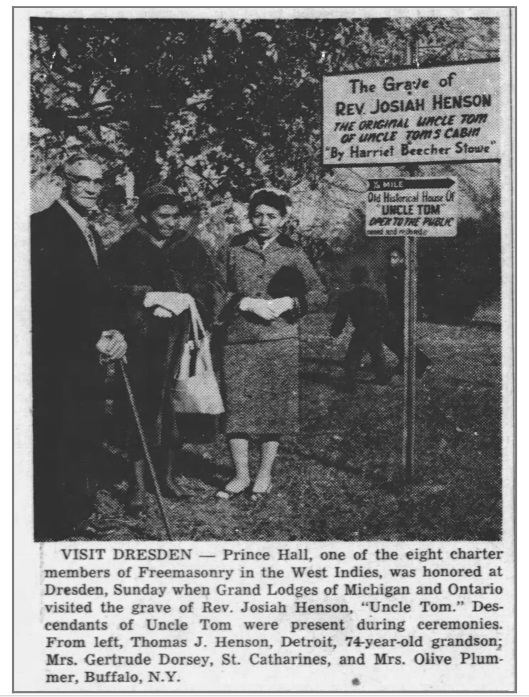
     Allan Alexander Dorsey or Deacon Dorsey is my 2nd-great grandfather who was born c.1840 in Tubman Country, Dorchester County, Maryland. He escaped from enslavement c.1857, settled in St. Catharines, and joined the BME Church where he met and married Samantha “Amanda/Mandy” Hemsley in 1863. Amanda was born in St. Catharines c.1844 and they had six children: Maurice, Lydia, Mary, Joseph Allan, William, and Frederick. Deacon Dorsey was a well-respected member of the community and served in that position at the Salem Chapel from 1868 until his death in 1882. Joseph Allan, Deacon Dorsey's son, is my great-grandfather. Joseph Allan is the father of my grandmother Inez Maude Frank (Dorsey), who is featured in the news article below.


Inez Maude Frank (Dorsey), Grandmother


Great Aunts, Sisters Gertrude Dorsey (L) and Olive Plummer (R)


    It is through my grandmother Inez Dorsey (Frank) that I am related to both my 3rd great-grandfathers Josiah Henson and the Rev. James Harper. My grandmother Inez is the daughter of Joseph Allan Dorsey (Deacon Dorsey's son) & Edith Harper. Edith is the daughter of Charles & Harriet (Collis) Harper. Charles is the son of Margaret and the Rev. James Harper; my 3rd great-grandparents. Another interesting fact that I learned is while my great-grandmother Edith was born in St. Catharines, her father Charles, his five siblings, and his parents Margaret and Rev. James Harper were all born in Columbia, South Carolina. It is from this location that they escaped slavery. So, who was the Rev. James Harper? He was Harriet Tubman's Pastor at Salem Chapel when she lived in St. Catharines, Ontario Canada. 


     When the First Annual AME Conference of Upper Canada was held in Toronto on July 21st, 1840, before their affiliation with the BME, Rev. James Harper was in attendance alongside my other more famous 3rd great-grandfather, Josiah Henson. Two years later in July 1842, the AME Churches of Upper Canada again gathered for a Conference but this time in Hamilton, Ontario Canada. At this Conference Rev. Harper was ordained an Elder and Josiah Henson was ordained a Deacon. Also present was Austin Stewart, Black Abolitionist who would eventually author the famous 1861 biography Twenty-two Years a Slave and Forty Years a Freeman. Another person who was present was Rev. Jacob Dorsey from the Salem Chapel, another one of my relatives who was born enslaved in Maryland around 1790 and escaped to Canada. 


     Josiah Henson was born enslaved in Charles County, Maryland June 15th, 1789. At the age of 41, he, his wife Charlotte, and four small children -two of whom he carried in a knapsack on his back- escaped from Owensboro, Kentucky. Forty-one days later they crossed to freedom in Fort Erie, Ontario Canada on October 28th, 1830, and settled into a Black community there known as Little Africa. Josiah would go on to lead a Black Militia during the Rebellion of 1837, found the Dawn Settlement in present-day Dresden, Ontario, establish the British-American Institute, and work as both an Abolitionist/Pastor. In 1849, at the age of 60, Josiah Henson's book “The Life of Josiah Henson, Formerly a Slave, Now an Inhabitant of Canada, as Narrated by Himself”, was published. As this book circulated among abolitionist reading rooms, Harriet Beecher Stowe, a young writer and abolitionist, learned about Josiah Henson. Upon one of his trips from Boston in 1849, he met Stowe at her home in Andover, Massachusetts. Two years later in 1851 Stowe wrote to Gamaliel Bailey, the editor and publisher of The National Era, and offered him a story for his antislavery paper that she had been working on. Published in The National Era on June 5th, 1851, Stowe's story Uncle Tom's Cabin ran in forty-one weekly installments for ten months. This series of articles used Henson's life story as source material, and centered him under the alias 'Tom' as the protagonist. These articles were published one year later in 1852 as the novel Uncle Tom's Cabin and became the best-selling novel of the 19th Century. 

     Stowe received a lot of negative backlashes and criticized as making the story up because it was a novel. To set the record straight, Stowe published a second book titled The Key to Uncle Tom’s Cabin one year later in 1853. It is in this book that Stowe recounts the life of “the venerable” Josiah Henson and exclaims that his life served as the basis of her famous novel. This book was seen as the spark that ignited the Civil War, which began on April 12th, 1861. In fact, when Stowe visited President Lincoln on December 2nd, 1862, he is reported to have said, "So you're the little woman who wrote the book that started this great war." In the midst of the Civil War, then President Abraham Lincoln began to draft a document which became The Emancipation Proclamation. Six months after meeting Stowe, on June 16th, 1862, President Lincoln checked out a copy of The Key to Uncle Tom’s Cabin from the Library of Congress and returned it forty-four days later on July 29th, 1862. This book was used as President Lincoln's primary source material to draft the Emancipation Proclamation, enacted six months later, on January 1st, 1863. 

My Father Philip B. Frank holding a picture of Josiah Henson,
his 2nd great-grandfather and my 3rd great-grandfather


     What I have shared just scratches the surface of the genealogy research that I have done on my family. It is a rich legacy of self-emancipation, education, community building, and preserving our cultural identity. Along with dozens of Underground Railroad freedom seekers who escaped to Canada, I have found family members draft cards who fought in WWI and WWII, Indigenous family members living on the Six Nations territory in Canada, violinists, members of the first Black hockey team in Ontario, the first Black person on a Canadian stamp, family members who chaired committees for immigrant aid societies, public speakers, poets, and etc. 

     There is a saying that we should live our lives as if a million ancestors were watching. All of us had two parents, regardless if we know them or not. This means that we had to have four grandparents, eight great-grandparents, sixteen 2nd-great-grandparents, thirty-two 3rd great-grandparents, and etc. This is not even considering numerous aunts/great aunts, uncles/great uncles, and cousins. That is our ancestry and our ancestors are literally a part of our genetic code (secret language/writing); we embody them. We are also a composite of their stories; their choices, accomplishments, failures, epiphanies, perseverance, pain, and joy. We are the evidence of what our ancestors did, what they didn't do, and what they hoped to do in their lifetime. Imagine knowing little to nothing about them and these stories. Consider the wealth of resources and reference books of wisdom that we don't have access to because we do not know them or their names. How well can we truly know ourselves without knowing much about where we came from, and the sacrifices that our ancestors made, that enabled us to be here? Consider the miracles that our family members performed or experienced over the generations, that we know nothing about. While each year gives us an opportunity to learn about and express our infinite potential, imagine not knowing how generations of family members have knowingly/unknowingly expressed their infinite potential in different areas of life. There is no advantage, asset, or value in not knowing who our people were, and are, to AND in us. If you're interested in learning about your family, Family Search is an excellent website to start, plus it's free. All you need is the desire to know, the diligence to search, and the love to share it with others, especially your family!


Peace,

Saladin


Saturday, June 09, 2018

What is the Niagara Falls Underground Railroad Heritage Center?


Take a journey and learn all about the new Niagara Falls Underground Railroad Heritage Center. The Niagara Falls Underground Railroad Heritage Center is an experiential museum that reveals authentic stories of Underground Railroad freedom seekers and abolitionists in Niagara Falls. The Heritage Center inspires visitors to recognize modern injustices that stem from slavery and to take action toward an equitable society. Take a brief tour of the Center with my Atlantis School For Gifted Youngsters Animation video below.


Address:
Niagara Falls Underground Railroad Heritage Area Commission
825 Depot Avenue
Niagara Falls, NY 14305

Email: info@niagarafallsundergroundrailroad.org
Phone: 716-300-UGRR (8477)

Heritage Center Hours:

Monday     Closed
Tuesday     10AM – 6PM
Wednesday   10AM – 6PM
Thursday   10AM – 8PM
Friday         10AM – 6PM
Saturday   10AM – 6PM
Sunday      10AM – 4PM

Admission Prices:

General Adult: $10
Student 13+ and college w/ID: $8
Youth 6 – 12: $6
Youth 5 and under: free
Group Rates Available - please email: tours@niagarafallsundergroundrailroad.org for more info.