Founder/CEO

Showing posts with label Underground Railroad. Show all posts

Wednesday, July 01, 2026

Historic! NYS Governor Signs Harriet Tubman Byway Into Law

Pictured (l-r): Third row -Josh Poole, Sage Hazarika | Second row: Nikita Jankowski, Jasiah Jackson, Char Rivera, Ally Spongr DeGon, Senator April Baskins, Sara Capen, Saladin Allah | First row: Xochi Jankowski, Noble Jankowski, Anusha Quanaah, Nevaeh Everett, Governor Kathy Hochul, Assembly Majority Leader Crystal Peoples-Stokes, Stokes' granddaughter


New York becomes home to its first state-designated Underground Railroad byway, a 176.76-mile route from Auburn to Niagara Falls honoring Harriet Tubman and Freedom Seekers — the first phase of a planned 550-mile border-to-border heritage corridor connecting Maryland to Canada.

   On Saturday June 13th, New York Governor Kathy Hochul signed legislation officially designating Phase 1 of the Harriet Tubman Underground Railroad Byway (HTURB) as part of New York's Scenic Byway System, enacting Senate Bill S9057A and Assembly Bill A10194A. The signing took place in Buffalo to kick off the 2026 Buffalo Juneteenth Parade and marks the first official designation of the 176.76-mile heritage corridor connecting 22 sites significant to Harriet Tubman, the Underground Railroad, and Freedom Seekers across eight counties from the City of Auburn to Niagara Falls. The Governor was joined for the signing by Senator April Baskin, Assembly Majority Leader Crystal Peoples-Stokes, New York State Attorney General Letitia James, New York State Comptroller Thomas P. DiNapoli, and was surrounded by members of the HTURB team — including Ally Spongr DeGon, Sage Hamilton-Hazarika, and Saladin Allah — whose work helped bring the designation to fruition. Following the signing, the HTURB team walked alongside the Governor, Attorney General, and Comptroller in the Buffalo Juneteenth Parade to its conclusion. 

On the 50th anniversary of Buffalo’s Juneteenth celebration, there could not be a more fitting time to sign the Harriet Tubman Underground Railroad Byway into law. I thank Governor Hochul for her support of this legislation, Assembly Majority Leader Crystal Peoples-Stokes for sponsoring this bill in the Assembly, and Saladin Allah and Lillie Wiley-Upshaw, two Western New York leaders in African American history preservation whose years of advocacy helped make this designation possible. I would also like to uplift the hard work of the New York State Department of Transportation, which spent years working diligently to shape this worthy piece of legislation. This byway honors Harriet Tubman, the Freedom Seekers who traveled through New York, and the communities that risked everything to help them. It formally recognizes that the road to freedom ran through our state and will create new opportunities for heritage tourism, local businesses, and economic development. When people travel these roads, they will see visible reminders that freedom, courage and resistance traveled them first. -Senator April Baskin

“Harriet Tubman’s life is a study in leadership, determination and the universal concepts of liberty and freedom. As we approach the 250th anniversary of the founding of the United States, it is important to remember and to celebrate people who exemplify the ideals this nation was founded on. Harriet Tubman, without a doubt, is one of those people. Now Ms. Tubman’s legacy is further ingrained here in New York State with the Harriet Tubman Underground Railroad Byway. I thank my colleagues in the Assembly, Senate and Governor Hochul for getting this legislation passed and signed.” -Assembly Majority Leader Crystal Peoples-Stokes

“There is no state in the nation with a larger Underground Railroad footprint than the Empire State, and this legislation will highlight a network of important sites along a newly created byway honoring the legacy of the Underground Railroad and one of the fiercest freedom fighters in American history – Harriet Tubman – who ultimately called New York her home. Generations ago, the Underground Railroad carved a path through a divided continent and enabled thousands of enslaved people to gain their freedom. Through the creation of this new scenic byway, we honor the legacy of the men and women who made this dangerous journey, paving the way for a new birth of freedom for millions of African Americans.” -Governor Kathy Hochul


   With the bill now law, the New York State Department of Transportation (NYSDOT) — in partnership with the Harriet Tubman Underground Railroad Byway Organization — will soon begin installing signage marking the route and connecting Underground Railroad landmarks across Central and Western New York. The route begins in Auburn, Cayuga County, passes through Seneca, Ontario, Wayne, Monroe, and Orleans Counties, then continues through Erie and Niagara Counties, and ends at Niagara Falls. The byway honors Harriet Tubman — who made her home in Auburn for 54 years (and where she’s buried), after escaping slavery and leading 70+ Freedom Seekers to liberty — and the broader Underground Railroad network that ran through New York State. Once fully implemented, the byway will bring visitors to well-known New York State landmarks such as the Harriet Tubman National Historical Park, two National Historic Landmarks, and 14 National Park Service Network to Freedom sites. The scenic byway will also connect visitors to existing Black neighborhoods, businesses, and other sites, encouraging travelers to tour and support communities along the route. As needed and appropriate, additional interpretation — in the form of kiosks, exhibits, events, or experience centers — will enhance the visitor experience by connecting the traveler with the byway’s historical significance. Recreational activities along the byway, such as the Empire State Trail and Erie Canal, will further expand the diversity of experiences available to visitors.


ECONOMIC IMPACT

The eight Phase 1 counties already generate $5.67 billion in annual visitor spending, supporting more than 64,000 jobs. With the new byway, there is potential to increase that number. Maryland’s comparable Harriet Tubman Underground Railroad Scenic Byway contributes $23 million in annual sales and supports 363 jobs. The Journey Through Hallowed Ground National Scenic Byway generates $1.06 billion in total business sales and more than 6,500 jobs across four states. Cultural heritage travelers — the byway’s core audience — spend an average of $1,182 per trip.


THE ROAD AHEAD

With Phase 1 signed into law, HTURB — housed within the Niagara Falls National Heritage Area will begin implementing the Corridor Management Plan (CMP) in partnership with NYSDOT and the Underground Railroad Consortium of New York State (URCNYS). More than 100 volunteers and numerous organizations participated in creating the CMP and supporting the byway’s designation. Phase 2 will extend the byway from Auburn east through 14 additional counties to Manhattan and the New Jersey border, creating a contiguous 550-mile border-to-border corridor. Seventy-nine municipalities across Phase 2 counties have already passed resolutions of support. Phase 2 designation legislation is proposed for the 2027 legislative session. The long-term vision connects the New York Byway into a continuous multi-state route from Dorchester County, Maryland — Harriet Tubman’s birthplace — to St. Catharines, Ontario, Canada, where Tubman guided Freedom Seekers to safety. Linking with the existing Maryland, Delaware, and Pennsylvania Harriet Tubman byways, and the proposed New Jersey byway, the full corridor would become one of the most significant heritage travel routes in North America.


ABOUT The Harriet Tubman Underground Railroad Byway

The Harriet Tubman Underground Railroad Byway Organization is the independent governing body of the designated byway, housed within the Niagara Falls National Heritage Area (NFNHA). It oversees governance, stewardship, tourism development, and the corridor’s expansion to a full border-to-border route.

The Harriet Tubman Underground Railroad Byway (HTURB) is now a New York State Scenic Byway spanning 550+ miles from Manhattan to Niagara Falls across 22 counties and more than 160 municipal jurisdictions. Phase 1, signed into law by Governor Hochul on June 13, 2026, designates 176.76 miles from Auburn to Niagara Falls across 8 counties and 22 heritage sites. The byway was initiated by the Underground Railroad Consortium of New York State (URCNYS) — a non-profit volunteer coalition of historians, tourism officials, heritage attractions, and descendants of Freedom Seekers, founded in 2015 — and has grown into its own independent organization, the Harriet Tubman Underground Railroad Byway Organization, supported by URCNYS and administered by the Niagara Falls National Heritage Area. For more information, visit our Harriet Tubman Underground Railroad Byway (HTURB) HERE or follow @tubmanbywayny.

Sunday, September 29, 2024

Genealogy and Discovering Our Roots

 
Marriage Certificate of Great Aunt Gertrude (Williams) Dorsey to Great Uncle Leo Joseph Dorsey.
In this certificate, Leo's parents Joseph -Allan- Dorsey and Edith Harper are highlighted. 


     Over the last few years, I have noticed a growing trend on social media of Black folks debating our ancestral origins and identity. What I rarely see are discussions on genealogy. Studying our family history and tracing our lineages would end much speculation about our identity and where we come from. Through this process, we find names, ethnicities, ages, genders, geographic locations, professions, property, and other documents. The best way that I can describe my own genealogical journey is "mind-blowing"! Check this out. 

    Before and following the August 1st, 1834 Abolition of Slavery throughout the British Empire, it is estimated that between 30,000 and 100,000 enslaved people escaped to freedom onto the Canadian side and established communities. When the Fugitive Slave Act was passed in 1850 by then-President Millard Fillmore, an exodus of free and enslaved black folks began to cross the Canadian and Mexican border. These patterns are clearly indicated in population census data and community activity on both sides of the U.S., Canadian, and Mexican borders during these time periods. During that time period, numerous family members on my father's side made that journey and helped establish or settle into Black communities within the Province of Ontario, Canada. From the records that I discovered, the majority of these ancestors were affiliated with AME (African Methodist Episcopal) Institutions that taught Black Liberation Theology. In addition to Little Africa, a Black community located in Fort Erie, Ontario, the other most notable community where my family members resided was Coloured Village in St. Catharines, Ontario.    

Salem Chapel BME Church

     Central to St. Catharines Coloured Village community was/is the Salem Chapel BME (British Methodist Episcopal) Church. This institution was built by formally enslaved people, freedom seekers, in 1855. One of Salem Chapel's most notable members was Harriet Tubman, who lived in St. Catharines from 1851 to about 1861 right across the street in a boarding house -which no longer stands. Initially established as an AME institution, the Salem Chapel and many other Canadian institutions became BME affiliated following the passage of the 1850 Fugitive Slave Act. Members refused to travel into the United States to attend annual AME Conferences for fear of being captured so they began to establish their own BME Conferences. Central to these institutions' Black Liberation Theology were civic protests, anti-slavery lectures, and the establishment of mutual aid committees to provide food, clothing, and shelter for newly arriving freedom seekers. There were other notable members of Salem Chapel during the time that Harriet Tubman worshipped there, and many were my relatives. 

St. Catharines Orioles; First Black Hockey Team in Ontario, Canada.
7 players were my relatives: Leverne "Larry", Amos and Gordon Dorsey,
Doug, Dick and Hope Nicholson, and Winifred Bell
 

     Allan Alexander Dorsey or Deacon Dorsey is my 2nd-great grandfather who was born c.1840 in Tubman Country, Dorchester County, Maryland. He escaped from enslavement c.1857, settled in St. Catharines, and joined the BME Church where he met and married Samantha “Amanda/Mandy” Hemsley in 1863. Amanda was born in St. Catharines c.1844 and they had six children: Maurice, Lydia, Mary, Joseph Allan, William, and Frederick. Deacon Dorsey was a well-respected member of the community and served in that position at the Salem Chapel from 1868 until his death in 1882. Joseph Allan, Deacon Dorsey's son, is my great-grandfather. Joseph Allan is the father of my grandmother Inez Maude Frank (Dorsey), who is featured in the news article below.


Inez Maude Frank (Dorsey), Grandmother


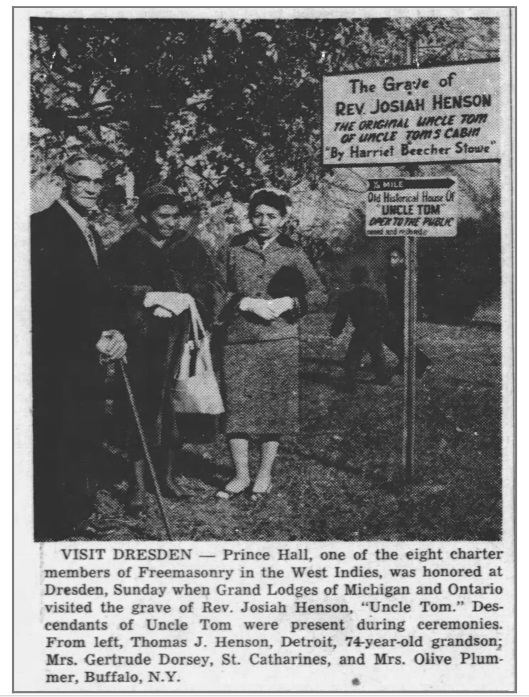
Great Aunts, Sisters Gertrude Dorsey (L) and Olive Plummer (R)


    It is through my grandmother Inez Dorsey (Frank) that I am related to both my 3rd great-grandfathers Josiah Henson and the Rev. James Harper. My grandmother Inez is the daughter of Joseph Allan Dorsey (Deacon Dorsey's son) & Edith Harper. Edith is the daughter of Charles & Harriet (Collis) Harper. Charles is the son of Margaret and the Rev. James Harper; my 3rd great-grandparents. Another interesting fact that I learned is while my great-grandmother Edith was born in St. Catharines, her father Charles, his five siblings, and his parents Margaret and Rev. James Harper were all born in Columbia, South Carolina. It is from this location that they escaped slavery. So, who was the Rev. James Harper? He was Harriet Tubman's Pastor at Salem Chapel when she lived in St. Catharines, Ontario Canada. 


     When the First Annual AME Conference of Upper Canada was held in Toronto on July 21st, 1840, before their affiliation with the BME, Rev. James Harper was in attendance alongside my other more famous 3rd great-grandfather, Josiah Henson. Two years later in July 1842, the AME Churches of Upper Canada again gathered for a Conference but this time in Hamilton, Ontario Canada. At this Conference Rev. Harper was ordained an Elder and Josiah Henson was ordained a Deacon. Also present was Austin Stewart, Black Abolitionist who would eventually author the famous 1861 biography Twenty-two Years a Slave and Forty Years a Freeman. Another person who was present was Rev. Jacob Dorsey from the Salem Chapel, another one of my relatives who was born enslaved in Maryland around 1790 and escaped to Canada. 


     Josiah Henson was born enslaved in Charles County, Maryland June 15th, 1789. At the age of 41, he, his wife Charlotte, and four small children -two of whom he carried in a knapsack on his back- escaped from Owensboro, Kentucky. Forty-one days later they crossed to freedom in Fort Erie, Ontario Canada on October 28th, 1830, and settled into a Black community there known as Little Africa. Josiah would go on to lead a Black Militia during the Rebellion of 1837, found the Dawn Settlement in present-day Dresden, Ontario, establish the British-American Institute, and work as both an Abolitionist/Pastor. In 1849, at the age of 60, Josiah Henson's book “The Life of Josiah Henson, Formerly a Slave, Now an Inhabitant of Canada, as Narrated by Himself”, was published. As this book circulated among abolitionist reading rooms, Harriet Beecher Stowe, a young writer and abolitionist, learned about Josiah Henson. Upon one of his trips from Boston in 1849, he met Stowe at her home in Andover, Massachusetts. Two years later in 1851 Stowe wrote to Gamaliel Bailey, the editor and publisher of The National Era, and offered him a story for his antislavery paper that she had been working on. Published in The National Era on June 5th, 1851, Stowe's story Uncle Tom's Cabin ran in forty-one weekly installments for ten months. This series of articles used Henson's life story as source material, and centered him under the alias 'Tom' as the protagonist. These articles were published one year later in 1852 as the novel Uncle Tom's Cabin and became the best-selling novel of the 19th Century. 

     Stowe received a lot of negative backlashes and criticized as making the story up because it was a novel. To set the record straight, Stowe published a second book titled The Key to Uncle Tom’s Cabin one year later in 1853. It is in this book that Stowe recounts the life of “the venerable” Josiah Henson and exclaims that his life served as the basis of her famous novel. This book was seen as the spark that ignited the Civil War, which began on April 12th, 1861. In fact, when Stowe visited President Lincoln on December 2nd, 1862, he is reported to have said, "So you're the little woman who wrote the book that started this great war." In the midst of the Civil War, then President Abraham Lincoln began to draft a document which became The Emancipation Proclamation. Six months after meeting Stowe, on June 16th, 1862, President Lincoln checked out a copy of The Key to Uncle Tom’s Cabin from the Library of Congress and returned it forty-four days later on July 29th, 1862. This book was used as President Lincoln's primary source material to draft the Emancipation Proclamation, enacted six months later, on January 1st, 1863. 

My Father Philip B. Frank holding a picture of Josiah Henson,
his 2nd great-grandfather and my 3rd great-grandfather


     What I have shared just scratches the surface of the genealogy research that I have done on my family. It is a rich legacy of self-emancipation, education, community building, and preserving our cultural identity. Along with dozens of Underground Railroad freedom seekers who escaped to Canada, I have found family members draft cards who fought in WWI and WWII, Indigenous family members living on the Six Nations territory in Canada, violinists, members of the first Black hockey team in Ontario, the first Black person on a Canadian stamp, family members who chaired committees for immigrant aid societies, public speakers, poets, and etc. 

     There is a saying that we should live our lives as if a million ancestors were watching. All of us had two parents, regardless if we know them or not. This means that we had to have four grandparents, eight great-grandparents, sixteen 2nd-great-grandparents, thirty-two 3rd great-grandparents, and etc. This is not even considering numerous aunts/great aunts, uncles/great uncles, and cousins. That is our ancestry and our ancestors are literally a part of our genetic code (secret language/writing); we embody them. We are also a composite of their stories; their choices, accomplishments, failures, epiphanies, perseverance, pain, and joy. We are the evidence of what our ancestors did, what they didn't do, and what they hoped to do in their lifetime. Imagine knowing little to nothing about them and these stories. Consider the wealth of resources and reference books of wisdom that we don't have access to because we do not know them or their names. How well can we truly know ourselves without knowing much about where we came from, and the sacrifices that our ancestors made, that enabled us to be here? Consider the miracles that our family members performed or experienced over the generations, that we know nothing about. While each year gives us an opportunity to learn about and express our infinite potential, imagine not knowing how generations of family members have knowingly/unknowingly expressed their infinite potential in different areas of life. There is no advantage, asset, or value in not knowing who our people were, and are, to AND in us. If you're interested in learning about your family, Family Search is an excellent website to start, plus it's free. All you need is the desire to know, the diligence to search, and the love to share it with others, especially your family!


Peace,

Saladin


Thursday, March 16, 2023

Descendant of Famed Freedom Seeker Pens Script

 
Saladin Allah and Host Anthony Morgan in of the Cataract House Gallery at the Niagara Falls 
Underground Railroad Heritage Center, CBC The Nature of Things

     Ken Cosentino -Niagara Falls resident Saladin Quanaah Allah, who goes by the mononym “Saladin,” is the third-great grandson of famed underground railroad freedom seeker Josiah Henson; whose life served as the inspiration for Harriet Beecher Stowe’s “Uncle Tom’s Cabin.” Last month, CBC’s “The Nature of Things With David Suzuki” featured Saladin as a historical expert and guest host alongside new co-host Anthony Morgan. The episode, titled “Secret Agents of the Underground Railroad,” was produced by Quebec-based company Attraction and filmed in Saladin’s hometown Niagara Falls, NY. The episode focused on the historic hotel called “The Cataract House,” which, due to its close proximity to the Canadian border, was a popular stop for freedom seekers along the Underground Railroad.

Stories abound of Harriet Tubman leading many enslaved people to freedom across the suspension bridge between Niagara Falls, NY, and Niagara Falls, Ontario. Lesser known are the stories of Cataract House staff who were secretly assisting enslaved people to board a rowboat at the foot of the American Falls across the Niagara River. This operation lasted for decades and was so well organized, it plays out like a spy novel. Only a small fraction of these stories were featured in the CBC documentary.

With the success of “Secret Agents of the Underground Railroad,” Saladin is currently finishing his treatment based on the Cataract House. Says Saladin, “It is important for me to honor our ancestors by keeping the story historically accurate. Several companies have already shown interest in producing this as a full-fledged series or feature, but as of right now there are no official commitments.” Saladin is a prolific writer and storyteller who has published twenty-three books, five of which are chronicled in the British Library. As an expert on the Cataract House and the Underground Railroad, Saladin has been featured in documentaries such as the award-winning docuseries “Enslaved,” narrated by Samuel L. Jackson; and the IMAX film “Into America’s Wild,” narrated by Morgan Freeman. Additionally, Saladin recently co-produced the documentary “Two Wars: The Road to Integration.” When he isn’t writing or being interviewed, Saladin can be found speaking to the United Nations and is the Director of Community Engagement at the Underground Railroad Museum in Niagara Falls, NY.

Abraham Lincoln utilized “Uncle Tom’s Cabin” as a key speaking point in his campaign for the oval office; Lincoln also drew directly from the literature while writing the Emancipation Proclamation. Says Saladin, “It is no secret who my third-great grandfather was, and how his life story came to impact the end of slavery.” Josiah Henson helped lay the tracks for the Underground Railroad, and for future underground railroad operatives such as Harriet Tubman.

CBC 2/2/23 – “Archaelogy is Rooted in Racism and Colonialism, Say Scientists. Here’s How We Rewrite ‘Everyone’s History'” – Featuring Saladin